Thursday, June 29, 2017

Still NOT Different This Time

A respected Wall Street analyst just predicted the Dow would end the year at 27,000.  This would require 25% growth in six months.  I cannot quite get my head around that.

For the nerds out there, the formula most commonly used to forecast the stock market is to multiply  earnings-per-share (EPS) times the price-earnings (PE) ratio.  To find EPS, you take average net earnings and divide it by the average number of shares outstanding.  To find PE, you take the current index value (say, the S&P) and divide it by the EPS.  It answers the question of how much will an investor pay for $1 of earnings?  A PE of 18 means an investor will pay $18 for each dollar of EPS.

The analyst's forecast was based on his belief that EPS would continue to increase at a 6-8% year-over-year rate and, that the PE of last year's EPS would increase from 18 to 20 times next year's EPS.  That EPS growth rate is more hope than analysis, I believe.  EPS bottomed out in Q1 of last year, especially for energy companies.  So, year-over-year comparisons will look less and less attractive.  While the PE of last year's earnings looks fully priced, the PE for next year's earning looks historically high.  Take a look at this graph:

Chart of the Day

(This graph uses last year's EPS, causing a higher PE than using next year's higher estimated EPS.)  

The point is that anything above 21 or 22 times EPS is getting into thin air.  That doesn't mean it cannot continue to increase, only that it can not be sustained for an indefinite period.  As before, the PE multiple must return to Earth . . . but not today.

Monday, June 26, 2017

Repealing A Foundation

What would happen if they repealed laws under cover of darkness and didn't tell anybody?

When I learned economics, one "law" was that  there was a relationship between unemployment and inflation.  It was a trade-off.  If you wanted less unemployment, you had to accept more inflation and vice versa -- if you wanted less inflation, you had to accept more unemployment.  (This was illustrated by the famous "Phillips Curve.")

Since the crash of 2008/9, unemployment has dropped from 10% to 4.3%.  Inflation should have increased dramatically.  While there are always some examples of inflation, overall inflation has been dormant.  Has that economic law been repealed?  If so, why?

Here are the most often-cited reasons:

1.  That relationship between unemployment and inflation never really existed.  The many instances of it in history were all coincidental.

2.  Intuitively, it makes sense that employers would have to pay more for fewer available workers when unemployment is low.  With the percentage of workers belonging to unions has dropped from 20% in 1983 to only 11% now, workers no longer have enough bargaining power to negotiate higher pay.  Globalization has also decreased the negotiating strength of workers.

3.  Workers were so frightened of losing their jobs during the crash of 2008/9, they have learned to be happy living without raises.

4.  Workers are simply worth less.  This is probably not the fault of workers.  Productivity has dropped in four of the last six quarters -- actually dropped, reflecting less capital investment in machinery and software to make workers more productive!  With corporate profits stashed offshore to avoid confiscatory taxes, there has been less money for capital investment in US workers.

5.  Wage growth is not correctly measured.  Employers have become creative in providing benefits like more vacation, as well as paying upfront signing bonuses, which are not normally counted as income.

6.  Wage growth can be expected to explode very soon.  It is a coiled cobra!

Now, all of this puts the Fed into a lawless state of confusion.  Should they raise interest rates to combat a non-existent problem with inflation?  NO!  This increases the cost of buying homes, as well the carrying costs of our national debt?  Should they raise interest rates just to be prepared to drop them the next time we have a recession?  YES!

I think the confidence level of most economists has decreased, with the realization that one of our most fundamental laws (the relationship between unemployment and inflation) has been repealed and nobody knew it.

Sunday, June 25, 2017

One Kudo, Mr. President.

My parents worked for the Federal government.  One was a good, conscientious worker, who received multiple promotions.  The other felt that any minimal effort was "good enough for government work."  I am intimately familiar with both perspectives.

The Veterans Administration has about 350 thousand employees.  I don't think of 50% of VA employees are useless and should be terminated.  I have met many, many fine employees in the VA.  But, I do think roughly 10% need to terminated immediately.  They clog the flow of health care.

Greatly complicating the problem is that the VA is the largest minority employer in the Federal universe.  To make sure minority employees were not fired as racial discrimination, the public employee union makes it unreasonably difficult to fire anyone, no matter how useless.  Minority protection might be a good primary function of the Federal government, but medical care of veterans is the primary function of the Veterans Administration.  Anything else must be secondary.

President Trump should be commended on signing new legislation that will make it slightly easier to fire the useless.  It is a step in the right direction, but much more needs to be done.

Saturday, June 24, 2017

Mind Maintenance

Philosophies can be described as overly-intellectualized coping strategies or ways to deal with the world and other people.  Maybe.  My intellectual drug-of-choice has long been existentialism, which sees the world through the prism of absurdity.  I have read many books on the philosophy, some were good and some were awful.  Still, it colors my views.

Recently, when I predicted the President would be impeached, my Republican friends started smelling a Democrat, while my Democratic friends rushed to welcome me.  One perceptive friend noticed my lack of emotion on the subject and suggested I was more stoic than existentialist.  Maybe.  It was less a partisan observation and more of a fiduciary observation, i.e., how will this expected outcome impact my clients?  Not every conclusion is partisan, and not every thought is an emotion.

Existentialism and stoicism are now collecting dust in philosophical waste bins and probably should be there.  Meanwhile, psychology seems to have taken the place of philosophy   Maybe.

A friend and client is exploring mindfulness, which Wikipedia defines as "the psychological process of bringing one's attention to the internal experiences occurring in the present moment, which can be developed through the practice of meditation and other training."  There is no doubt in my mind that mindfulness will definitely increase your years, as well as your enjoyment of those years!  That is the easy part, but it doesn't come easily.

Just as marathoners run a real risk of over-training, a person can work their mind too much for too long and exhaust it.  Mind maintenance requires a periodic shutdown before being refilled.  Mindfulness is a great help -- and healthy too.  But, it is not a light switch to be suddenly flipped on.  It is a way-of-life to be pursued.  If you only learn one exercise, learn to breathe.  

Think you already know how to breathe?  Nope!

Monday, June 19, 2017

A Spade

According to Wikipedia:  "Regulatory capture is a form of political corruption that occurs when a regulatory agency, created to act in the public interest, instead advances the commercial or political concerns of special interest groups that dominate the industry or sector it is charged with regulating."

I would only add one word . . . Airlines . . . 


Friday, June 16, 2017

Little Lessons

I was a teenager when I read Leon Uris' classic Exodus, about the Holocaust survivors making their way to Israel and building their own nation.  Though it was fiction, I enjoyed the story and learned a great deal of history.

As a young veteran when the Yom Kippur war between Israel and Egypt broke out in 1973, I was massively impressed with Israel's defense capability.

When I lived in Washington, I briefly shared an office with a Palestinian refugee and was reminded how there are always two sides to every story, which tempers my enthusiasm.

In 2009, I read Dan Senor's eye-opening book Start-up Nation, describing a nation born in 1948 with no natural assets and surrounded by enemies, yet it lifted itself up by its own bootstraps, albeit with a little help from the U.S.  The takeaway from Senor's book was that Israel's success was due to their choice between military/economic success and loss of national sovereignty.  He did not attribute any of their success to a lack of institutions.

I just finished a new book by Katz and Bohbot entitled The Weapon Wizards, which is an excellent, more narrowly-focused, sequel for Senor's book.  Describing Israel sixty years ago as primarily an exporter of oranges and false teeth, its main exports today are electronics, software and medical devices.  It is also the world's sixth largest exporter of weaponry, about $7.5 billion annually.  Israel spends 4.5% of GDP on Research & Development, the most of any nation, and 30% of that goes for military R&D, compared to 17% in U.S. and a miserly 2% in Germany.  The authors quote the man behind their satellite program, who famously said "the shadow of the guillotine sharpens the mind," as a reason for their success.

I find it hard to believe that the 8 million people of Israel are any more innovative than the 330 million people in the U.S, but I am impressed by the number of Pentagon officials trekking to Israel for inspiration.  I am even more impressed that tiny Israel has 1,100 defense companies and has the third-most companies listed on the U.S. Nasdaq stock exchange.

The book would be improved by a comparison of new product life cycles.  From the moment of inspiration, how long does it take for the plans & specs to be approved, for initial funding, for beta-testing to begin, for formal approval, for sustained funding to be identified, and for the annual audit process.  In a nation as large as the U.S., institutions play an important role, up to the point when they become crippling.  How will we know when we have reached that point?

The elephant can learn from the mouse, indeed!

Thursday, June 15, 2017

Cause vs. Symptom

While I wish a full and speedy recovery, both physically and psychologically, for those victims of yesterday's horrific attack on Republican politicians as well as their families, I also hope this tragedy will jump-start a discussion on our worsening inability to disagree.

Some see the attack as another example of our gun problem.  One sarcastic pundit said, since there are more guns than human beings in this country, there is no excuse for the politicians NOT to be carrying a concealed weapon during baseball practice, so they could return fire at any time.  Also, since it was the Republican party that foiled Obama's efforts to control gun violence, another pundit suggested that the photos of the baseball-field tragedy would do more than the photos of the Sandy Hook school tragedy.  Hyperbole!

Some see the attack as another example of the infotainment industry and the opinion shows that started on AM radio, migrated to satellite radio, and now appear on cable "news."  The bombastic Rush Limbaugh now seems almost quaint and tame, compared to some on-air "infotainers," such as the hyperbolic Alex Jones.

I see both the gun problem and infotainment as mere symptoms of the real cause, which is gerrymandering.  That is the act of drawing political districts in a particular manner, so as to insure the election of a particular political party.  The objective is to make those districts safe for either Republicans or for Democrats.  A district that is safely Republican is likely to elect the "most Republican" candidate and unlikely to elect a moderate.  Of course, the Democrats are also less likely to elect a moderate Democrat in a safe Democratic district.  Partisan purity is an advantage in a safe district but is a disease in Congress!

Gerrymandering discriminates against moderates and favors extremists, who cannot compromise and therefore should not govern.  As more extremists are elected, more hyperbole shows up in Congress, in the papers and on the airways.  Increasing hyperbole seems to precede increased gun violence.

Politicians cannot be trusted to draw their own district lines.  That heavy responsibility should be given to an independent commission of voters.  If politicians won't let voters decide the district lines, that responsibility should be given to the courts.  Anybody but the elected politicians!

Some things are too important for politicians!

Wednesday, June 14, 2017

Interest Rates 101

A reader asked why Wall Street obsesses constantly about interest rates?  Whenever the Fed changes interest rates, they only do it by a quarter point, so what's the big deal?

Simple question?  Yes.  Simple answer?  No!  Entire text books have been written on interest rates, but here are a few factoids.

Interest rates determine the amount of interest you pay on mortgages and other loans.  They also determine how much income you earn on bonds and savings.

Interest rates may be fixed or floating.  As the word implies, fixed rates are determined by a third party, usually the government, such as U.S. Savings Bonds, and those rates do not change until maturity.  Floating rates are determined by the supply and demand for those particular types of financial instruments, such as Treasury bonds.  Those rates fall when the demand for those bonds increases more than the supply of those bonds.  Remember, the value of bonds fall as interest rates rise, because the amount of interest paid remains constant, regardless of the value of the bonds.  (Dividing the constant payment by increasing bond value produces decreasing yield.)

Interest rates have many lengths or maturities.  Short-term rates are usually lower than long-term rates, because long-term lenders take more risk than short-term lenders, such as inflation.  The risk of inflation is greater over the long-term than the short-term.

Interest rates are economic indicators.  The relationship between short-term rates and long-term rates is one economic indicator.  An increasing difference means the marketplace thinks that either inflation is rising, which is bad, or economic activity is increasing, which is good.  A decreasing difference is often indicative of a pending recession.

Interest rates indicate the amount of fear in the market.  When the yield on Treasury bonds drops suddenly, it is because investors got scared of stocks, sold their stocks, and used the cash to buy bonds, which means the demand for bonds increased, which increases price, but which drives down the yield.

Interest rates are economic tools.  The Fed can control short-term rates easily, but not long-term rates.  If the economy is over-heating, the Fed raises interest rates to reduce corporate profits and growth.  If the economy is weak, the Fed does the opposite, as they did in the face of the recession in 2008/9.

Interest rates change currency values.  Suppose you are a German earning nothing on your cash-euros but you can earn 1% if your savings were in US dollars.  To take advantage of that increased earnings, you would have to sell your euros, which drives down the value of euros, and then you would have to buy dollars, which drives up the value of dollars.  So, increasing interest rates increases the value of the currency.

A mere discussion of interest rates can change the stock market.  If Fed Head Janet Yellen said that interest rates need to be "normalized" (read:  3%) quickly, the stock market will suddenly sink.  She doesn't need to do anything except talk.

Libertarians believe democracy is never safe, when the Fed is meeting.

The Fed is meeting this week . . .

Monday, June 12, 2017

A Foreign Perspective

When the President withdrew the United States from the Paris Accord on Global Warming, he understandably argued that the U.S. had tougher goals than China, which is the world's greatest polluter.  Why shouldn't they have the tougher goals?  It is a good argument.

From the Chinese perspective, the U.S. has historically been the world's greatest polluter.  The U.S. grew wealthy and powerful by burning fossil fuels for 150 years.  They argue it is not fair to those newly industrialized nations not to have the same benefit as the United States.  That is also a good argument.

It is also significant that the Chinese are already fighting pollution aggressively.  I was in Beijing a few years ago and could barely breath.  Neither could the Chinese.  They have cancelled over a hundred coal-burning electricity facilities this year alone.  Two-thirds of all workers in the world, who are involved in the production of solar energy, already work in China.  That's about two million workers, and it shows, because solar energy production has increased a whopping 80% so far this year.  From a geopolitical standpoint, oil-vulnerable China is seriously committed to freedom from oil and is committed to both solar and wind energy.

At the same time, we are protecting the jobs of 400 thousand coal workers, who might as well be digging buggy-whips out of the ground.  Coal has already lost the battle to natural gas.  Coal production has dropped every year since 2013 and will continue to do so.  Natural gas is both cheaper and cleaner.

As the world's new leader in the fight against global warming, China will now be able to attract the best and brightest young engineers and technical workers.  They will also attract rivers of private financing.  Coal mines don't need any more financing.

The Chinese did not need the Paris Accord to get serious about fighting pollution.  They just needed to breath in Beijing.  

Saturday, June 10, 2017

Mental Health Advice

For some years, I have advocated a "news-free" day.  Most of us keep close tabs on the news provided by our favored news source.  Of course, it is essential to gather news from those news sources that both agree AND disagree with your point of view.  However, it is also important to maintain perspective.  To do so, you must be free of the news habit from time-to-time.  News-gathering is addictive, and I am clearly a victim.

Seeking to flee the breathless 24/7 coverage of the Trump-Comey conflict, I actually watched RT, which stands for Russia Today.  It is a propaganda machine of the Kremlin.  I expected it would mirror US coverage -- saying there was NO Russian interference in the 2016 presidential election.  To my surprise, the subject was not even covered.  Instead, it was full of  "US-led airstrikes in Syria target scores of women and children."  Ignoring such patently-absurd headlines, their coverage is full of military strategy, i.e., what kind of forces are deployed where and how their supply lines function.  From a military standpoint, it was actually quite interesting.

But, the point is -- take a break, preferably a "cold-turkey" break and avoid all news for one day every week.  Play golf!  Go to the beach!  Listen to your kids!  Amuse your spouse!  It might even be fun . . .

Neither Trump nor Comey care what you do -- only you care!  Now, pick up that remote . . . yes, you CAN do it . . .

Wednesday, June 7, 2017

Soothsaying 101

I have been a member of the National Association of Business Economists for many years and always read their quarterly survey of members.  Here are some of their latest forecasts:

1.  There has been a minor slowing of economic activity.  Despite a weak Q1, they expect Q2 to bounce back with a 3.1% growth rate.  Full-year GDP growth is estimated at 2.2% this year and 2.4% next year.  Both estimates are down a minor 0.1% from the last survey.

2.  We will continue producing about 170 thousand jobs each month, and inflation will remain quiet.

3.  Nine out of ten economists believe there is less than a 25% probability of a recession this year, while three out of four believe there is less than a 25% probability next year.

4.  The Fed will raise interest rates twice this year and three times next year.

5.  By a large majority, members assume the Trump Administration will be successful in both tax reform and infrastructure spending by late next year and will be good for the economy, but the effects will not be visible before Congressional elections next year.

Any questions?

Tuesday, June 6, 2017

Crossing My Fingers

Dr. Jeremy Siegel of Wharton has long been one of my favorite thought-leaders.  His comments on the latest Jobs Report are that it was a disappointment, as the number of jobs created was less than expected.  Plus, there were downward revisions to two previous months.  (Still, unemployment at 4.3% is at a 16-year low,).  He is mildly surprised that the stock market did not have a negative reaction to the report and concluded it was offset by falling interest rates and the depreciating dollar, which is especially supportive of large cap stocks.

More important to me, as someone who confesses a certain fondness for Dr.Siegel, he looks terrible!   His face is suddenly thin, and he has lost most of his hair,  Today, his weekly commentary begins with an ominous "Over the coming months, while Professor Siegel receives treatment for health  related matters . . ."

I wish him well, as it would be a less-bright and a less-bullish world without him!

Monday, June 5, 2017

The Dollar Matters

Following the December increase in interest rates, the dollar has increased in value, which makes dollars more expensive to buy for foreigners and makes the goods of foreigners cheaper for Americans for buy.

The data on the April trade data has just been released, and the stronger dollar shows up clearly, as Americans bought more goods from foreigners (which increases our imports) and foreigners bought fewer goods from us (which decreases our exports).

Exports fell by $483 million, and imports rose by $1.9 billion.  The monthly trade deficit increased by $2.3 billion to $47.6 billion.  If we convert those numbers into percentages of GDP, exports fell 0.4% and imports rose 1.3%.  This is important, because a trade deficit is a drag on GDP growth -- a minor one, but still a drag.

The value of the dollar has now slowed.  If the Fed doesn't raise interest rates this month, we may actually see a little welcome depreciation in the cost of the dollar.  With respect to our short-term trade deficit, I hope so.  However, with respect to normalizing the long-term level of interest rates, I hope they do raise interest rates.  Yes, the U.S. economy can afford it!

Friday, June 2, 2017

20 Years Wasted


Since the Kyoto Protocol in 1997, diplomats have been negotiating a treaty to limit carbon dioxide in the atmosphere.  I'm proud to say that those long, tedious negotiations were led by the United States, which produced a treaty acceptable to 195 nations.  Yesterday, we abdicated that leadership role, in favor of China and Russia.

Ronald Reagan called on us to be "the shinning city on the hill" . . . and we were!

I am sad . . . too sad to write.

Thursday, June 1, 2017

Let Us Pray . . .

Well, I'm not a scientist -- the argument always begins that way -- but I don't need to be a scientist to stick my nose close to the exhaust pipe on my car and know I don't like the air coming out of it.  It would be hard for me to ever believe such nasty air is not bad.  Plus, I don't have to be a scientist to believe the vast majority of people who are actual scientists.

The Pentagon has accepted the fact that sea-levels are rising due to global warming and pose a serious national security risk.  I think they probably know more about that than I do.

I hope and pray the President doesn't abdicate our global leadership on global warming by withdrawing from the Paris accord, which limits the growth in carbon-based pollutants.  This gives global leadership to China and Russia, leaving the U.S. in the company of Syria and Nicaragua, the only other nations who didn't sign the Paris accord.

I stand with Al Gore, who characterized global warning as an "Inconvenient Truth."  It is extremely inconvenient . . . and costly in the short run!

I stand proudly with Mitt Romney and John McCain, the 2012 and 2008 Republican nominees for President, who begged the President to stay in the Paris accord.

Please, Mr. President . . .

Wednesday, May 31, 2017

Lacking Data

The health of your portfolio is like a stool, dependent upon three strong legs, i.e., economic issues, market issues, and geopolitical issues.  But, how can you determine if the legs are strong enough to support the value of your portfolio?

Looking for economic data is definitely "drinking from a firehose."  There is almost too much to absorb and is never 100% consistent.  Nonetheless, I am confident when I say the economy is looking good -- not great, but good enough.  I can support that with lots of data.

Looking for market data is a little more academic, but there is plenty to study, e.g., trading volume, advance/decline line, VIX, etc.  There are lots of graphs, such as this one:

Chart of the Day

The graph shows there is no reason to expect the long-term bullish trend to change, which is good news.  Furthermore, corporate earnings growth looks to continue.  There are even old Wall Street adages, like "the trend is your friend," suggesting you should stay bullish.  There are lots of datapoints.

Looking for geopolitical data is another matter.  It is much more subjective.  What really matters?  What doesn't?  Is it presidential popularity?  Is it war somewhere?  Or peace elsewhere?  Is it elections?  How do you measure the strength of the geopolitical leg?

Your head can analyze the first two issues, but you need your stomach and decades of experience for the third issue.

Tuesday, May 30, 2017

Deficits Matter

The history of popular economic thought really started in 1776 with the seminal work of Adam Smith, entitled The Wealth of Nations.  It was the genesis of the classical or Austrian school of economics, popularized by Ludwig von Mises.  During the Great Depression, another school of economic thought was popularized by John Maynard Keynes, and it was understandably called Keynesian economics, although it is sometimes called Demand-side today.  Ronald Reagan brought the third school of economic thought to the country, called Supply-side economics.

As a college student during the 1960's, I was taught Keynesian economics almost exclusively.  During a lunch with Arthur Laffer, the godfather of Supply-side economics, in 1978, I became fascinated and studied various experiments in Supply-side economics.  However, as some experiments failed so badly, I have gravitated back to the Austrian school, which means deficits really matter a great deal.

With that in mind, I have studied the President's new budget proposal and am glad it is "dead-on-arrival."  It is pure Supply-side, meaning the deficit does explode if the economy doesn't explode.  It is dependent on explosive growth in GDP.  That ain't going to happen!

Our $20 TRILLION debt is going to jump, with this proposal. Trump is right to curb entitlement growth, but he is doing it in the most heartless fashion, such as cutting health care for the poor.  The two biggest budget gluttons are Social Security and Medicare, which are untouched by this budget proposal, because recipients of those huge programs vote in huge numbers.  As a beneficiary of both, I would recommend they both be cut.  At the very least, eliminate the cost-of-living increases and limit spending on high-income recipients like myself.

Am I happy about a tax cut for me?  Of course!  I moan and curse every quarter when I write that check to the IRS.  But, writing that check is good for the country.  Supply-side disciples believe I will take my tax savings and create new jobs.  No, that ain't going to happen either.  I will save the money, which creates no jobs, and hurts the country.  To suggest that all tax cuts increase revenue growth, then what happened to the Bush tax cuts?  Have you looked at what happened in Kansas?  Yet, the Administration wants us to believe GDP will grow, reducing the deficit.  This is called "dynamic scoring," which I describe as economic ignorance.

The Kennedy tax cut and the Reagan tax cut were successful in increasing GDP growth.  A tax cut today would not!  DOA is a good thing.


Saturday, May 27, 2017

Saluting the Best

I like holidays.

I like Christmas and Easter,
the high holy days for Christians,
as well as Hanukkah and Passover,
the high holy days for Jews.

I like Veterans Day,
a thank-you note to those who wore a uniform,
as well as Fourth of July,
a celebration of summer and politicians.

I even like the silly holidays,
such as Valentines' Day,
a high holy day for romantics and jewelers.
Did you know there is even a National Pancake Day?

But, Memorial Day is so very, very different.
It is the most emotional, the most meaningful.
It is a time to remember the very best of us.
To me, it is THE high holy day!

I will remember . . . I will never forget!

Thursday, May 25, 2017

Youth Wasted ?

Conventional thinking about the current condition of the labor market is misleading.  That thinking is that unemployment is getting low, so low that it will pull discouraged workers back into the market to look for jobs.  They point to the low percentage of the population that actually has jobs, dropping from 63.4% in 2007 to 58.2% in 2010 although rising to 60.1% now.

The Republican viewpoint is that social programs, like unemployment & disability, are encouraging people to avoid jobs.  The Democratic viewpoint is that the decrease reflects the aging of our workforce.  Neither is correct.

Deeper analysis shows that the workforce contains more older workers (>54) than expected while the pool of discouraged workers (U-6 unemployment) contains more younger people that expected.   Normally, we stop counting people as eligible for work at age 55, even though many still hold jobs.  If included, the percentage of the population employed is about 62.2% -- close to the 2007 high.  This is a relatively simple measurement issue.

Not so simple, the problem is the large number of young people in the pool of discouraged workers.  This includes people who work part-time jobs, because they cannot get full-time jobs.  It is a more complicated problem, because it is structural in nature.  It is a reflection of an out-dated educational system, with huge legacy costs, that prepares young people for 20th century jobs, not 21st century.  It is a reflection of a parenting system, where a child's self-esteem is more important than his level of knowledge, and immaturity is unknowingly encouraged.  At this point, it is irrelevant what caused so many young people to find themselves in the pool of discouraged workers.  How do we get them out?

As the economy approaches very FULL employment, what companies can afford the training costs of hiring kids out of their parents' basements?

Tuesday, May 23, 2017

R.I.P. Manchester Kids

President Trump is correct in calling terrorists "evil losers," but I suspect they were losers first, who subsequently became evil.  Maybe, they were losers because they never had a chance to "hold a job or hold a woman's hand."  When the birthrate exceeds job growth, heartbreak follows.  Better birth control and more jobs would help.  Poverty often produces misfits, but religion can make them evil, and all religions feel persecuted.  Unfortunately, it is just too easy to blame their persecution and problems on Western civilization.

The most interesting thing on the President's first foreign trip is the impressive new Saudi center for monitoring terrorist recruiting on the internet.  There is very little public information on this new center, but I wish them well. The Sunni Saudis are finally getting engaged in the first against terrorism.  They even promised to crack down on their citizens funding terrorist organizations.  Better late than never.

Another day, another terrorist attack, another up day in the stock market, all is well . . . NOT!

Saturday, May 20, 2017

Gone But Not Forgotten

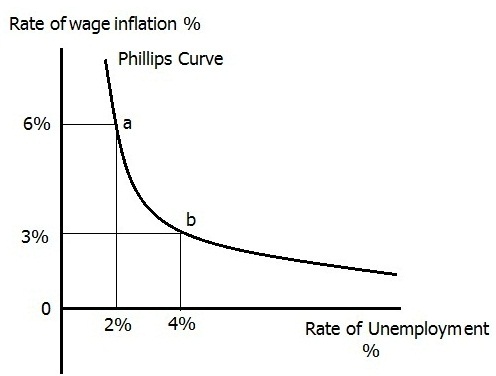
Young economists believe there are two types of economists.  There are those who STILL believe in the Phillips Curve, and then there are the young economists.  The Phillips Curve suggests there is a predictable relationship between inflation and unemployment.  Graphically, it looks like this:

Image result for phillips curve

In this academic example, if the rate of unemployment is 4%, it can be reduced to 2% by raising inflation from 3% to 6%.  Or, if you want to reduce inflation from 6% to only 3%, you can do so by increasing unemployment from 2% to 4%.

Our younger brethren argue that this is simplistic, in that other factors come into play.  AGREED!
They argue that it has broken down entirely since the global financial crisis.  AGREED!
They argue that the curve is not static but moves constantly.  AGREED but the relationship stays!
They argue that it cannot be proven mathematically.  AGREED, but you cannot prove the existence of God mathematically either.

The important thing is -- that the Phillips Curve still frames policy discussion.  Intuitively, it makes sense to me that inflation can be dampened by driving up unemployment, which removes spending power in the economy.  You can do this by raising interest rates.  This is exactly what Fed Head Paul Volcker did.  In March of 1983, inflation reached a nosebleed level of 14.8%.  Volcker drove up interest rates to a terrifying 20%.  The prime interest rate was 21.5%, and unemployment soared to 10%.  The economy promptly went into recession, but inflation fell to a mere 3% by 1983.  In the short-term, Volcker was condemned for putting the burden of ending inflation on the backs of the working poor.  In the long-term, he has been hailed as courageous.

Now, what should Chair Yellen do today, when neither unemployment nor inflation are problems?

Young economists say that proves the Phillips Curve is irrelevant, since neither unemployment nor inflation are problems.  It is irrelevant only inside the bubble that has existed since 2008.  As economic conditions normalize, with higher interest rates and lower budget deficits, it will become increasingly relevant.  Of course, exactly when will that happen?

Friday, May 19, 2017

. . . On With The Show

It was March 21st that I predicted the President would be impeached.  My objective then was to study how impeachment might impact my clients' portfolios.  After studying the impeachments of Andrew Johnson, Nixon, and Clinton, I concluded there is no predictable pattern.  (Still, as the market goes down when uncertainty goes up, I felt it would be appropriate to remove some risk by raising cash.)

At the time, I expected Republicans to lose the House but retain the Senate in next year's midterm elections.  In that case, the President would be impeached by the House but not convicted in the Senate and therefore not removed from office.  (In Clinton's case, the market started rising as soon as the Senate trial began, as it was obvious he would not be convicted.)

Now, I suspect there is a greater likelihood the President will resign before he can be impeached.  His former ghostwriter says the President doesn't understand right or wrong, only winning or losing - that's a huge difference.  When he realizes he cannot win, he will just declare victory and resign.  Jeremy Siegel, the legendary professor at Wharton, predicted the Dow would suddenly jump a thousand points when that happens.

Right now, the Republican goals of tax reform and infrastructure stimulus are seeping out of Wall Street dreams.  A President Pence would reduce the drama and restore the GOP dreams.  It might cause the bear market I expect to occur sooner but to be less severe.

If so . . . on with the show, please!

Wednesday, May 17, 2017

Silent Costs

Economists are fond of discussing opportunity costs.  According to Investopedia:  (1) An opportunity cost is the cost of an alternative that must be forgone in order to pursue a certain action.  Put another way, the benefits you could have received by taking an alternative action. (2.) The difference in return between a chosen investment and one that is necessarily passed up.

In other words, the cost of an aircraft carrier is not $10 billion.  It is 10 regional hospitals, plus the value of improved regional health, plus the incremental additional tax revenue produced by healthier people, plus . . . plus.  You get the picture.

As we begin wading into the deeper waters of the Trump presidency, the media will be blamed for his problems, ignoring the fact that media exists only to please advertisers.  Coverage of this train-wreck will be 24/7 because it brings eyeballs to advertisements.  If Americans would watch the Lifetime channel or National Geographic or anything else on cable, instead of news/opinion programs, the media would chase those eyeballs.

But, there is another silent cost.  We are not debating a new tax plan, we are not debating an infrastructure/stimulus program, we are not debating minimum jail sentences, nor a host of other important issues.  The oxygen is being sucked out of the room, and that's a shame!

Impeachment is bad for the economy, and it is not a one-time charge.  There will be a cumulative effect on the economy that continues for years.  Perhaps, that is the opportunity cost of democracy.

And don't expect the stock market to be happy about this!

Tuesday, May 16, 2017

The Right to Quibble

I don't know how many generations of my family have served in the military, except that we have served during every war since the Civil War.  We were always taught to love this great country, which makes it difficult for me to understand Republicans or Democrats.

When Democrats get in trouble, they blame rich people, like the Koch brothers.  When Republicans get in trouble, they blame the media.  (Sometimes, people just get themselves into trouble!)

Republicans believe "that government is best which governs least," and they are right.  Democrats believe "we are a village" including the "least among us," and they are right.  Why then is the partisanship so bitter?

Is it because we live in the separate echo chambers of Fox News and MSNBC?  Is it because we have nothing to bind us, like an old-fashioned war?  Is it because we have no "lift of a driving dream?"

But, we have passed the point of silly!  I remember when sexists would watch a beauty pageant and comment on the beauty of the ladies, while feminists would watch and comment on how accomplished the participants are, as well as their wardrobes.  The latest Miss USA produced a winner who was raised in Virginia Beach and has a degree in chemistry and a job with the U.S. government in nuclear engineering.  She is a very accomplished person, indeed!  Yet, there is a controversy between Republicans and Democrats, over her belief in health care being either a right or a privilege.  Is there anything partisans will not quibble about?

Which is worse . . . chauvinism or hyper-partisanship?

How many mothers's sons died to protect our right to quibble?  Or, is it a privilege?

Saturday, May 13, 2017

Rainy Day Gratitude

Sitting here on a cold rainy morning contemplating the political turmoil ahead of us, I am grateful for those who manufacture smiles:

https://www.youtube.com/watch?v=KnYjQHkHnD8